Can AI see your website?
More and more visits come from AI reading your site, not a person. Here's how we build websites that both people and machines can read and understand
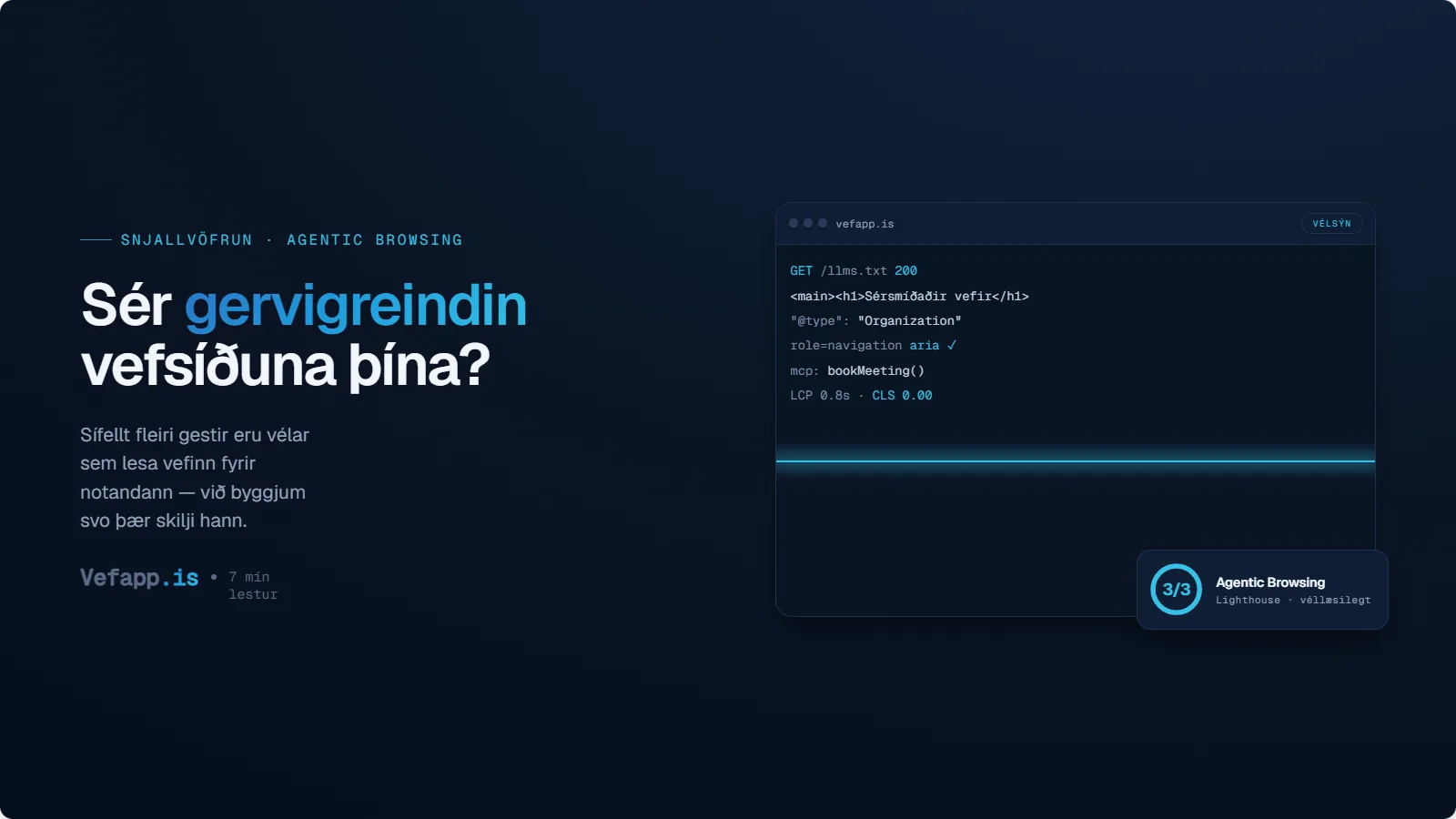
More and more visits to the web don't come from a person scrolling. They come from AI reading the page on the user's behalf. ChatGPT, Claude, Copilot, Gemini and Perplexity search, compare and book. New browsers do the same. A website built for the eye alone is largely invisible to these readers. At Vefapp.is we build websites that both people and machines can read and understand.
What is ?
Agentic browsing is when AI browses the web on the user's behalf. It reads pages, extracts facts, compares options and carries out actions, such as filling in a form or making a booking. This is not search in the ordinary sense. The machine reads the content, makes a decision and acts on it.
The difference between this and the old search engines matters. A search engine reads the web and ranks it. Agentic AI reads the web and uses it.
Google is measuring this now
In May 2026, Google added a new category to , the quality measurement tool built into Chrome. The category is called Agentic Browsing and arrived with 13.3 on 7 May 2026. It checks whether machines can actually read the site and use it, not just whether a search engine can index it.
The category is still experimental. It doesn't give a score from 0 to 100 like the other categories, but rather a fraction of tests passed, for example 3/3. Google doesn't call this a ranking factor, but a signal of whether the site is ready for machines. But history tells us that once starts measuring something, the web industry starts fixing it. That happened with speed in 2020, and with accessibility before that.
The thinking is the same as with accessibility. What makes a site readable to a screen reader also makes it readable to AI. The , which the browser builds, is exactly what agentic AI reads first.
What makes a site machine-readable?
Six things matter most. The first two also help people using screen readers, so the work pays off twice.
1.
A small text file at the root of the site that works like a map for language models. It tells the AI what the site is and points to the most important pages. Think of it as robots.txt, but for language models. Jeremy Howard of Answer.AI proposed the file in September 2024, and it is defined at llmstxt.org.
It's worth noting that this is a consensus, not a formal standard, and none of the major language models have promised to read it. But it's cheap to build, checks for it, and it gives you control over what content the machine reads first.
2. Server-rendering and semantic
AI reads and the , not the picture on the screen. A site that draws all its content with in the browser can therefore be invisible to the machine when it arrives. We pre-render content on the server, with proper headings and markup, so it's there from the very first response.
3. Structured data
Schema.org and describe what the things on a page actually are. A company, a product, a price, a review, a question and an answer each get their own tag. This lets AI understand the context instead of guessing, and cite the content correctly.
4. Accessibility that machines rely on
A well-formed , correct heading order, and descriptions for images and buttons. The same work that helps people using screen readers makes the site understandable to AI. An unlabelled button fails the same test for a machine as it does for a screen reader.
5.
A new standard that lets a site expose its actions, forms and tools in a way AI can safely use, instead of having to guess at buttons. The site tells the machine what it can do, instead of the machine having to work it out from the interface. Google and Microsoft are developing the standard together within the W3C, and it landed in its first Chrome trial in early 2026.
This flips the balance of effort. Today, the machine has to figure the site out. With , the site tells the machine what's possible. It's worth noting that the standard is still taking shape and currently only runs in Chrome, so this is an investment in what's coming, not a finished system across all browsers.
6. Speed and stable layout
Machines give up on a slow site, just like people do. Fast first render and a layout that doesn't jump around matter for visitors, for Google, and for the new Agentic Browsing category. If content shifts while a machine is about to click on it, it misreads the page.
How we do this
This isn't an add-on we sell separately. It's part of how we build. Every site is pre-rendered on , with semantic , structured data and from day one.
This very site, vefapp.is, scores full marks in Google 's Agentic Browsing category. The reason is simple: we build it by the same rules we use for the sites we build for our clients.
More on machine-readable websites and Agentic Browsing: vefapp.is/agentic.
Sources
- Agentic Browsing, Chrome for Developers: scoring
- "A developer toolkit to make your website agent-ready", Chrome for Developers: blog
- in first trial, Chrome for Developers: blog
- , Answer.AI: llmstxt.org
- Schema.org: schema.org
More posts
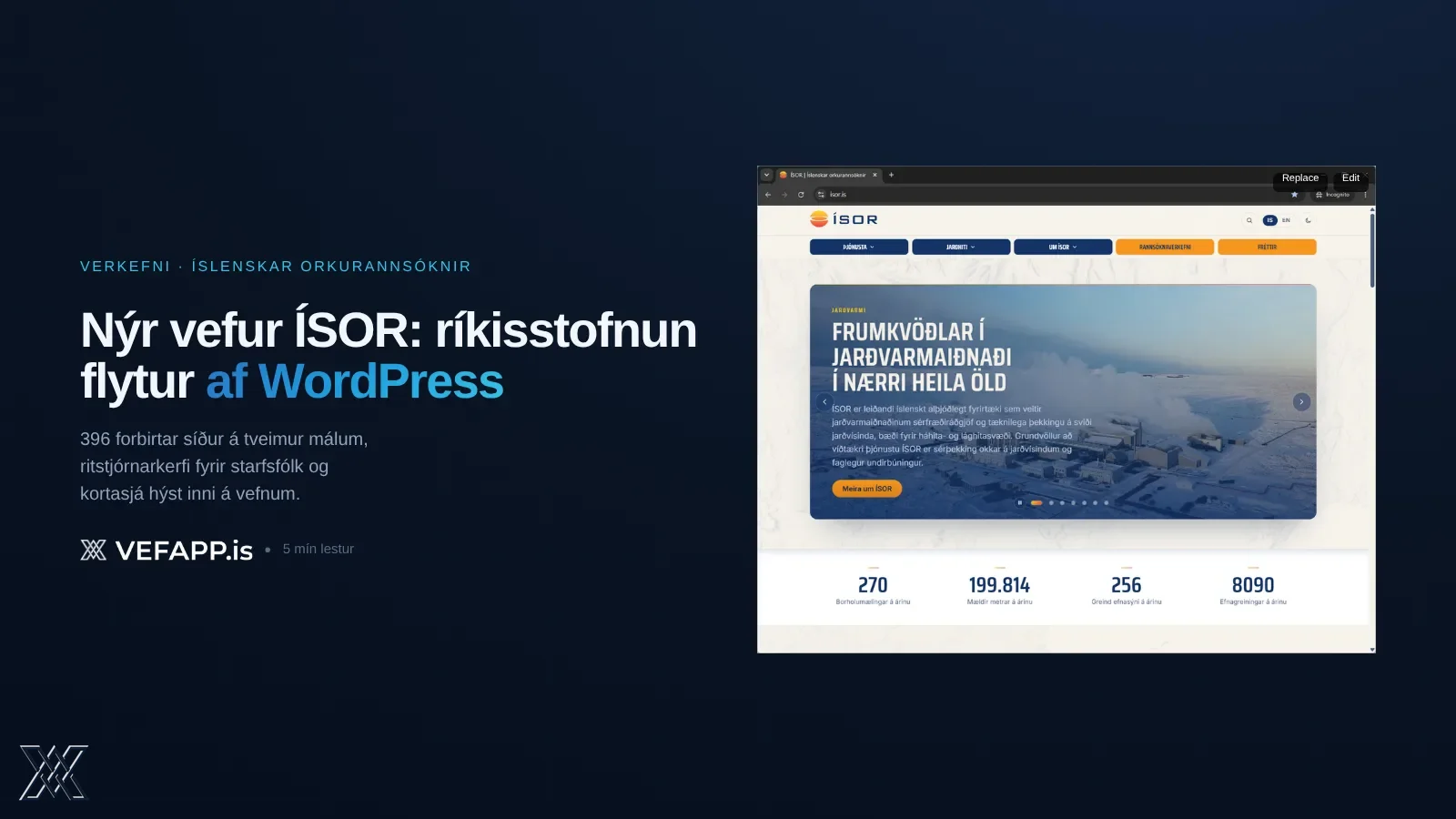
6 September 2026 · 6 min read
The new isor.is: a public institution moves off WordPress
isor.is went live on 4 September 2026: 396 pre-rendered pages in Icelandic and English, a CMS the staff run themselves and the map viewer hosted inside the site. How Vefapp's largest project so far went.